
How Many EAN Codes Do I Need? Count Them Right First Time
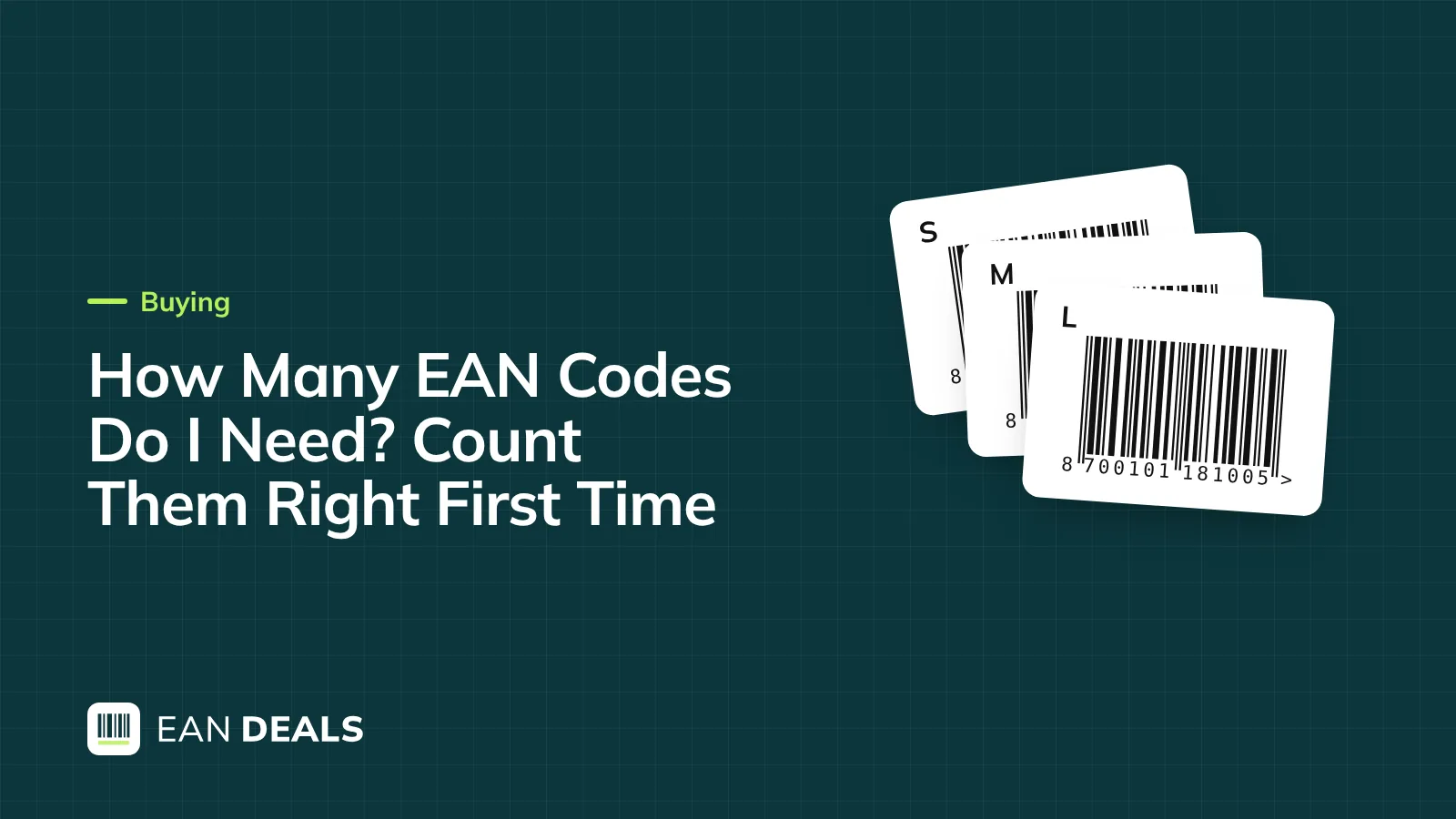
You need one EAN code for every version of a product a customer can buy separately: each size, colour, flavour, pack size and bundle. You do not need one per individual item in stock.
Key points
- One code per sellable variant, not per unit on the shelf.
- A 3-pack, a gift set and a bundle each need their own code.
- Restocking the same item never needs a new code; changing its contents or size can.
- Never reuse a code for a different product: GS1 has banned reuse since 2019.
- Pick a pack that covers today's range plus the launches you have planned for the next year.
You have a spreadsheet of products open, a pack of barcodes in your basket, and one nagging question: will 10 be enough, or should you buy 100 just in case? How many EAN codes do I need? It is the question every new seller asks, and the answer is one for every version of a product a customer can buy on its own: each size, colour, flavour, pack size and bundle. Stock levels do not matter. A thousand identical mugs share one code; a mug in three colours needs three.
Below you will find the counting rule, three worked examples from typical UK shops, the product changes that do and don't need a new code, and a simple way to choose a pack size without paying for numbers you will never use.
The one rule: one code per sellable variant
Think about it from the till's point of view. When a scanner reads a code, it has to know exactly which product, at which price, is being sold. If your small and large candle shared a code, the system could not tell them apart. GS1 Nederland uses a neat example: black and white athletic socks in three sizes need 6 codes, and if you also sell them in packs of three, you need another 6.
So, for every product, ask: could a customer put this exact version in their basket separately? If yes, it needs its own code.
| You sell… | Own EAN? | Why |
|---|---|---|
| Same T-shirt in S, M, L | Yes, 3 codes | Each size is bought separately |
| Same mug in 3 colours | Yes, 3 codes | Each colour is a different item |
| 3-pack of socks | Yes, 1 extra code | A multipack is a new trade item |
| Gift set you put together | Yes, 1 code | A bundle is its own product |
| 200 more units of the same mug | No | Same product, more stock |
| Same mug on Amazon and eBay | No | One product, one code everywhere |
| New product photos or price on site | No | Nothing physical has changed |
Google Merchant Center follows the same logic: each product and each variant in a different colour or size has its own GTIN.
T-shirt 'Thames' design
| Black | White | Navy | |
|---|---|---|---|
| S | …00013 | …00020 | …00037 |
| M | …00044 | …00051 | …00068 |
| L | …00075 | …00082 | …00099 |
| XL | …00105 | …00112 | …00129 |
| XXL | …00136 | …00143 | …00150 |
15 variants = 15 EAN codes
How many EAN codes do I need? Count them in four steps
- List every productOne row per product line in a spreadsheet.
- Multiply the variantsSizes × colours × flavours × pack sizes for each line.
- Add bundles and setsEvery gift set, multipack and bundle gets one more code.
- Add next year's launchesCount products you have actually planned, then pick a pack.
Do it in a spreadsheet, not in your head. The same file later becomes your code register: one column for the EAN, one for the product and variant, one for the date you assigned it.
Three worked examples
1. A clothing brand on eBay and Shopify
Josh runs a small streetwear label from Bristol. He has two T-shirt designs, each in five sizes (S to XXL) and three colours, plus a hoodie in one colour and four sizes.
- T-shirts: 2 designs × 5 sizes × 3 colours = 30 codes
- Hoodie: 1 colour × 4 sizes = 4 codes
- Total today: 34 codes
- Planned for spring: one new design in the same sizes and colours = 15 codes
Josh needs about 49 codes within the year. A pack of 50 fits almost exactly, which leaves him one spare. If he were unsure about the spring design, he could start with a pack of 25 plus a pack of 10 and top up later.
2. A loose-leaf tea shop with tasting sets
Sarah blends loose-leaf tea in six flavours, each in a 50 g and a 100 g pouch. She also sells two fixed tasting sets: one with three black teas and one with three herbal blends.
- 6 blends × 2 sizes = 12 codes
- 2 tasting sets = 2 codes
- Total: 14 codes
If her range is settled, a pack of 10 plus a pack of 5 covers it with one to spare. If she adds seasonal blends every winter, a pack of 25 is the calmer choice. And if she later changes which teas go into a tasting set, that is a different bundle and needs a new code, because the contents have changed.
3. A phone accessories reseller
Dan sells unbranded silicone cases for six phone models in two colours, plus a case-and-screen-protector bundle for each model.
- Cases: 6 models × 2 colours = 12 codes
- Bundles: 6 models × 1 bundle = 6 codes
- Total: 18 codes, with new phone models arriving every autumn
Here a pack of 25 makes more sense than a pack of 10 plus another 10, because Dan knows new models will keep coming.
When a product change needs a new code
Most day-to-day changes don't. A new price on your website, new photos, a better description or a restock of the same item all keep the existing code. Under GS1's GTIN Management Standard, a new code is needed for bigger changes, such as a different declared net content (a 100 g pouch becomes 80 g), a dimension or gross-weight change of more than 20%, a new primary brand, or different contents in a pack or bundle.
For counting, the lesson is simple: keep a few spare codes for changes you can already see coming, such as a packaging switch next year or a reworked gift set.
And once a code has been used for one product, it stays with that product. GS1 UK states that from January 2019 GTINs should never be reused. Under the old rules apparel codes could be recycled after 30 months and grocery codes after 48; that is no longer allowed. Marketplaces also remember old code-to-product links for a long time, so reusing a code is a quick way to end up with the wrong product page, as explained in our guide to EAN codes already in use.
Choosing a pack size without overbuying
Overbuying is not a disaster, because bought-once codes do not expire and there is no yearly fee to keep them. But there is no point paying for 1,000 numbers if your realistic five-year range is 60 products.
A practical rule:
- Count today's range using the steps above.
- Add only launches you have actually planned for the next twelve months.
- Choose the smallest pack that covers both. If you sit right on the edge, go one size up rather than buying two small packs.
Our EAN checker is handy after buying: run one or two numbers through it to confirm they are valid before you print labels.
Common counting mistakes
These are the slips that leave sellers short of codes halfway through a launch, or with a listing attached to the wrong product:
- Counting products instead of variants. "We sell 12 products" often means 12 designs in four sizes each, which is 48 codes.
- Forgetting multipacks. A single and a 3-pack of the same item are two products. So are a 3-pack and a 6-pack.
- Giving a bundle the code of its main item. Your own gift set needs its own code on eBay, in your shop and on the box. (For Google Shopping feeds, Google asks for the main product's identifiers on seller-made bundles, so check each channel's rule.)
- Using a supplier's barcode for your own version. If you change the product, add your brand or repackage it, it is no longer the supplier's item.
- Re-using the code of a discontinued product. It is tempting when a line ends, but it is exactly what the 2019 rule forbids.
A quick sanity check: your number of codes should equal the number of rows in your stock system where a customer could buy the item separately. If those two numbers differ, one of the mistakes above is usually the reason.
How this compares with GS1 UK
At GS1 UK, the smallest plan for businesses with a turnover up to £99,999 costs £50 a year and includes 10 GTIN-13s. Extra numbers cost £25 a year for 10 or £50 a year for 100 (checked October 2026, excluding VAT). Based on those published prices, a small business pays roughly:
- 10 codesBase plan£50/yr
- 20 codesBase plan + 10 extra£75/yr
- 110 codesBase plan + 100 extra£100/yr
That fee repeats every year for as long as you use the numbers. With codes bought once, you pay once. The trade-off is that our codes are recorded in our register, not in GS1's, so your company does not appear in Verified by GS1.
When GS1 is the better choice
Count your codes the same way, but buy them from GS1 UK if you sell branded products on Amazon, supply supermarkets or retail chains, or need your company listed in GS1's registry. Our guide on what to check before you buy explains that choice in more detail.
What to do now
- Put every product line in a spreadsheet and multiply out sizes, colours, flavours and pack sizes.
- Add one code for every bundle, gift set and multipack.
- Add only the launches you have actually planned for the next year.
- Pick the smallest pack that covers the total, and record each code against one product the day you assign it.
- Never move a used code to a different product.
Frequently asked questions
Do I need a different barcode for each colour?
Yes. A red and a blue version of the same mug are different products to a scanner, a warehouse and a marketplace. Google Merchant Center says each product variant, such as a different colour or size, has its own GTIN. Give each one its own EAN and record which is which.
Do I need a barcode for every single item I sell?
No. All 500 units of the same black T-shirt in size M share one EAN. The code identifies the product version, not the physical item. Serial numbers are a different thing and are not what marketplaces ask for in the barcode field.
Can I use the same EAN on Amazon and eBay?
Yes, and you should. The EAN belongs to the product, not to the sales channel, so the same mug carries the same code on Amazon.co.uk, eBay.co.uk and your own shop. Using different codes for one product on different sites creates confusion in feeds and stock systems.
What happens if I run out of codes?
You simply buy another pack. Codes from different packs work side by side; nothing links a product range to one batch of numbers. Just keep adding them to the same spreadsheet so each code still points to exactly one product. See all packs.
Do I need a barcode for the outer carton?
Only if a warehouse or trade buyer asks for it. Outer cartons use a GTIN-14, usually in an ITF-14 barcode, and that is mostly a wholesale and retail-chain matter. For marketplace listings and your own shop you only need codes for the consumer units.
Sources
More articles
All articles-
 Buying Buy EAN Codes in the UK: What to Check Before You Pay You can buy EAN codes once, without a yearly licence, and use them for unbranded goods and your own shop. Before you pay, check that each number is unique, recorded against you and sold without false GS1 claims. 9 min read
-
 Marketplaces Barcode for Amazon UK: Selling With or Without GS1 Amazon.co.uk asks for an EAN or UPC in most categories and checks it against GS1 data. For a branded product, use GS1 codes licensed to you or apply for a GTIN exemption; non-GS1 codes are only realistic for Generic listings, and even then without guarantees. 9 min read
-
 Marketplaces EAN Codes for eBay UK, Etsy and OnBuy: What Each One Needs eBay.co.uk asks for an EAN in many categories but accepts 'Does not apply' when your product truly has none. Etsy rarely needs one for handmade items, and on OnBuy you should check the barcode field for your category before you buy. 8 min read
-
 Troubleshooting EAN Already in Use? Why It Happens and How to Fix It An 'EAN already in use' error means the marketplace already links that number to a product, often because the code was sold or used before, or because two of your own variants share it. Find which cause applies before you change anything. 9 min read