
Buy EAN Codes in the UK: What to Check Before You Pay
You can buy EAN codes once, without a yearly licence, and use them for unbranded goods and your own shop. Before you pay, check that each number is unique, recorded against you and sold without false GS1 claims.
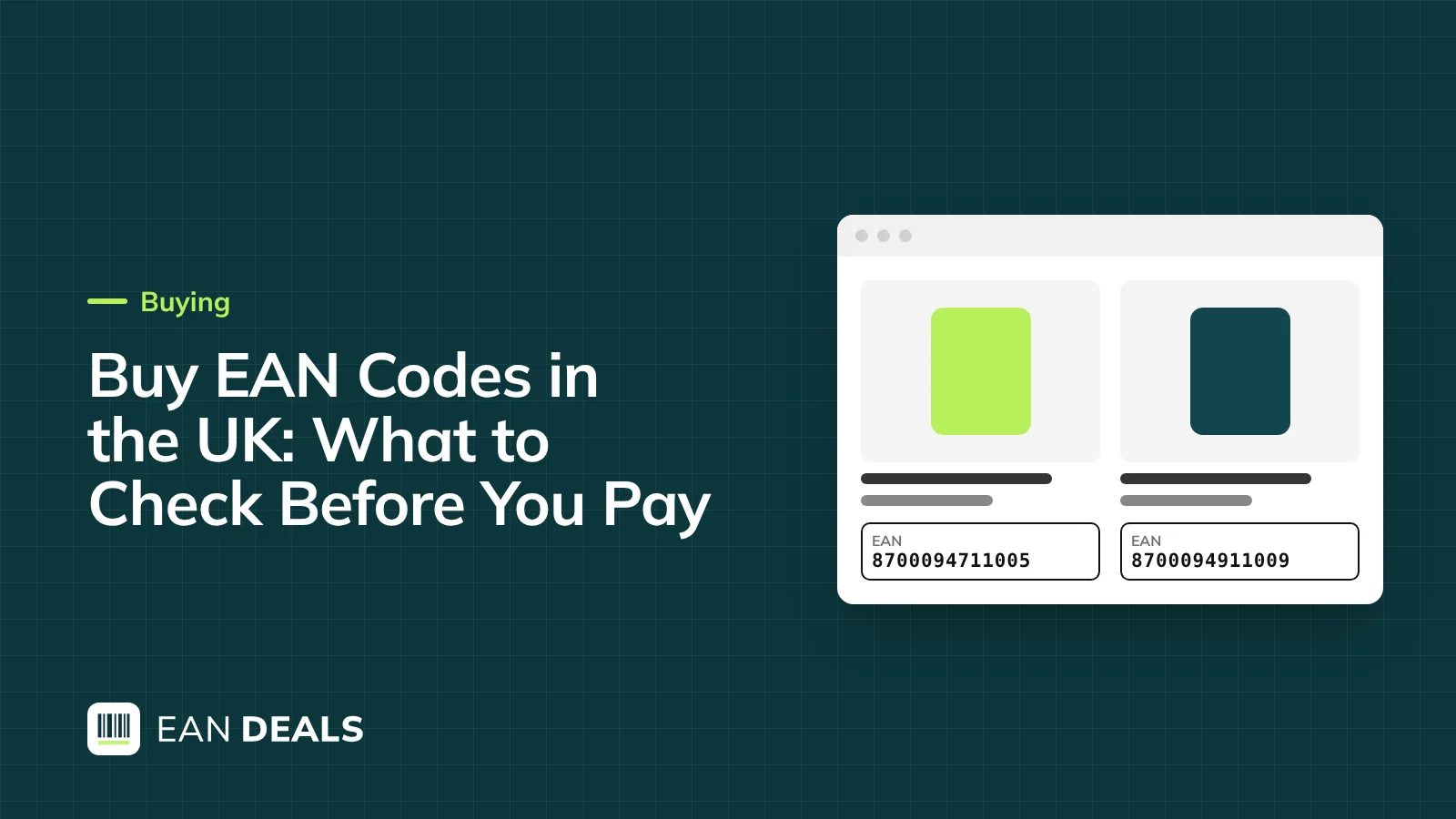
Key points
- A bought EAN code is a number; the barcode image can be generated from it for free.
- The biggest risk is a code that has been sold to someone else too, so ask how uniqueness is guaranteed.
- Nobody outside GS1 can sell 'official GS1 codes'. Treat that claim as a red flag.
- GS1 UK starts at £50 a year for 10 codes (checked October 2026); bought-once codes have no renewal.
- Branded products on Amazon, supermarkets and chains need GS1, not resold codes.
You have a batch of plant pots, phone cases or dog leads ready to list, and the marketplace form wants a barcode. A quick search turns up a dozen websites that will sell you EAN codes for less than a takeaway. Can you buy EAN codes like that, and which seller can you trust? Yes, you can buy EAN codes once and use them for unbranded products, eBay and your own webshop. Before you pay, check that every number is unique, recorded against you, sold without false GS1 claims and priced without a hidden subscription.
This guide gives you the checklist we would use ourselves, the red flags that should make you close the tab, and an honest comparison with GS1 UK, including the cases where GS1 is simply the better buy.
What you are actually buying
An EAN code (officially a GTIN-13) is a 13-digit number. The black-and-white barcode is just a picture of that number, and you can generate it for free once you have the number. So when you buy EAN codes, you are paying for the number and for the promise that nobody else has it.
There is no UK law that says a product must carry an EAN. The rules come from two places:
- GS1's licence terms. GS1 is the organisation that runs the barcode system. GS1 UK licenses numbers to its members every year, and that licence cannot be passed on.
- Marketplace and retailer rules. Amazon, supermarkets and many other buyers decide which codes they accept.
Codes from a seller like us are valid EAN-13 numbers, issued once and recorded in our own register against you. They are not a GS1 membership in your name. That difference matters for some channels and not at all for others, which is why the checklist below starts with uniqueness and ends with your sales channels.
Before you buy EAN codes: the 7-point checklist
Run through these seven checks before you buy EAN codes from anyone, including us.
| # | Check | Good sign | Red flag |
|---|---|---|---|
| 1 | Never sold twice | Clear promise and a register | No mention of uniqueness |
| 2 | Recorded against you | Lookup page shows your purchase | Just a PDF or an email list |
| 3 | Honest about GS1 | Says plainly it is not GS1 | "Official GS1 codes", "GS1-approved" |
| 4 | Price model | One-off price, stated up front | Low first year, then a renewal |
| 5 | Valid numbers | 13 digits, correct check digit | Codes starting 02, 04 or 2 |
| 6 | What you receive | Numbers in your account, barcode files | Only images, no numbers |
| 7 | Fits your channels | Seller explains where codes work | "Works everywhere, guaranteed" |
1. Has the number ever been sold to someone else?
This is the check that matters most. If the same EAN was sold to two sellers, the second one to list it lands on the first seller's product page, or gets an "EAN already in use" style error. Ask the seller how they prevent this. A believable answer involves a register that records each number against one buyer. "Our codes are unique" with nothing behind it is not an answer.
2. Is there a record that the code is yours?
A register gives you evidence if a competitor or marketplace questions your listing. At EAN Deals every number is recorded against your account in the gtincodes.com register, and anyone can check it there. Be clear about what this does and does not do: it is not a GS1 registration. In GS1's own lookup, Verified by GS1, a code that did not come from your own GS1 membership will not show your company.
3. Does the seller tell the truth about GS1?
GS1 is the only body that issues GS1 company prefixes, and the prefix shows which GS1 office issued it, not where a product is made. GS1 Australia goes further and warns that unauthorised barcode sellers can undermine the integrity of the whole system. So any reseller claiming its codes are "official", "GS1-registered" or "GS1-approved" is either confused or misleading you. Honest sellers say what they are.
4. Is it really a one-off price?
Some offers look cheap because the first year is cheap. Read the small print for words like "annual", "renewal" or "subscription". Our codes are paid once; there is an optional paid protection plan, but the codes stay yours whether you take it or not.
5. Are the numbers technically valid?
Every EAN-13 ends in a check digit calculated from the other twelve. Paste a sample into our EAN checker before you print anything. Also look at the first digits: numbers starting with 02, 04 or 2 sit in GS1's restricted ranges for in-store use, and Google Merchant Center rejects them.
6. What lands in your account?
You should receive the numbers themselves, in a format you can copy into a spreadsheet or listing. Barcode images are a nice extra, but you can always make those yourself with a barcode generator.
7. Will the codes work where you sell?
A seller who promises acceptance "everywhere" is not being straight with you. More on this in the GS1 section below.
- List your channelsWrite down every marketplace and shop where the product will be sold.
- Count your productsOne code per size, colour, flavour and pack size you sell.
- Check the sellerUniqueness, register, honest GS1 wording, one-off price.
- Test a codeRun one number through a checker before you print labels.
Red flags that should stop you
Codes from auction sites and bulk spreadsheets deserve extra suspicion. They are often the same numbers sold over and over, which is exactly how listings end up attached to someone else's product. If that has already happened to you, our guide to fixing "EAN already in use" walks through the clean-up.
Worked example: a small ceramics studio
Ellie makes ceramic plant pots in her studio in Stroud: three glazes in two sizes, plus a fixed set of three small pots. She sells on eBay.co.uk and her own Shopify shop, and has no plans for supermarkets.
- 3 glazes × 2 sizes = 6 codes
- 1 pot set = 1 code
- Total today: 7 codes, with two new glazes planned for spring (2 × 2 sizes), so 11 within the year.
Before paying, she runs the seller through the seven checks: a register she can look up, no GS1 claims, one price with no renewal. She then picks a pack that covers 11 codes, copies the first number into the Barcode field of her first Shopify variant and runs it through the checker. Each size and glaze gets its own number, because a 12 cm pot and a 15 cm pot are different products to a scanner. If you are unsure how to count your own range, see how many EAN codes you need.
GS1 UK or buying once: the honest comparison
GS1 UK charges by turnover. From the published plans (checked October 2026, excluding VAT):
| Annual turnover | GS1 UK fee per year | GTIN-13s included |
|---|---|---|
| Up to £99,999 | £50 | 10 |
| £100,000 – £499,999 | £100 | 100 |
| £500,000 – £999,999 | £130 | 1,000 |
| £1m – £9,999,999 | £200 | 1,000 |
Extra numbers cost £25 a year for 10 or £50 a year for 100. The key word is year: GS1 UK says GTINs are licensed annually, and if you cancel your membership "you will no longer have access to your GS1 GTINs".
| – | GS1 UK | Codes bought once |
|---|---|---|
| How you pay | Every year | Once |
| Recorded against you | In GS1 registry | In our register |
| Your firm in Verified by GS1 | yes | no |
| Branded products on Amazon | yes | no |
| Supermarkets and chains | yes | no |
| Unbranded goods, own webshop | yes | yes |
When GS1 is the better choice
Buying codes once is the smart move for many small sellers, but not for all. Choose GS1 UK if any of these apply:
- You sell a branded product on Amazon. Amazon checks codes against GS1 data and compares the brand. A code licensed to another company does not match your brand. Our Amazon guide covers the GTIN exemption route too.
- You supply shops, supermarkets or retail chains. GS1 UK warns that in retail the GTIN will be checked and products rejected if it is not registered to you.
- You need your company to appear in Verified by GS1, for example because a trade buyer asks for it.
Selling a branded product on Amazon?
YesGS1 or a GTIN exemption
Supplying shops, supermarkets or chains?
YesJoin GS1 UK
Must your firm show in Verified by GS1?
YesJoin GS1 UK
Codes bought once fit well
If all three answers are no, paying a yearly licence buys you little that you will use.
What to do now
- List every channel you sell on and answer the three questions above.
- Count one code per sellable variant, plus what you will launch this year.
- Check any seller against the seven points, including us.
- Test one number in an EAN checker before you print.
- Keep a simple spreadsheet linking each code to one product, and never reuse a code for something else.
Frequently asked questions
Are barcode resellers legit?
Selling EAN numbers is not illegal; no UK law says a product must carry a GS1 barcode. The rules come from GS1's licence terms and from each marketplace. A reseller is legitimate when it is honest about what you get: a valid, unique number that is not registered to you at GS1. Avoid anyone claiming their codes are GS1-approved.
Do EAN codes expire?
The number itself never stops being a valid EAN-13. What can end is the right to use it: GS1 UK says that if you cancel your membership you no longer have access to your GS1 GTINs. Codes bought once from us have no renewal to miss.
Can I make up my own EAN code?
You can calculate a valid check digit for any 12 digits, but that does not make the number yours. A made-up code may already belong to another product, which leads to wrong product pages and listing errors. Google Merchant Center also tells sellers not to guess or make up a GTIN.
How quickly do I get the codes after buying?
With us the numbers appear in your customer account straight after payment, ready to copy into your listings or into our free barcode generator. With GS1 UK you first join as a member and then allocate numbers to your products in their online tools. Either way, test one number before you print a full run of labels.
Is it cheaper to buy EAN codes or join GS1 UK?
It depends on how long you sell. GS1 UK costs £50 a year for 10 codes at the smallest turnover band (checked October 2026), every year. Bought-once codes are paid once. If you need GS1 for your channels, though, cheaper codes are a false economy.
Sources
- Updates to membership plans – GS1 UK
- How much does GS1 UK membership cost? – GS1 UK
- Leaving GS1 UK – GS1 UK
- I bought GTINs somewhere else, can I update my listings with GS1 GTINs? – GS1 UK
- GS1 Company Prefix – GS1
- Verified by GS1 – GS1
- Barcode integrity – GS1 Australia
- GTIN [gtin] – Google Merchant Center Help
More articles
All articles-
 Buying How Many EAN Codes Do I Need? Count Them Right First Time You need one EAN code for every version of a product a customer can buy separately: each size, colour, flavour, pack size and bundle. You do not need one per individual item in stock. 9 min read
-
 Marketplaces Barcode for Amazon UK: Selling With or Without GS1 Amazon.co.uk asks for an EAN or UPC in most categories and checks it against GS1 data. For a branded product, use GS1 codes licensed to you or apply for a GTIN exemption; non-GS1 codes are only realistic for Generic listings, and even then without guarantees. 9 min read
-
 Marketplaces EAN Codes for eBay UK, Etsy and OnBuy: What Each One Needs eBay.co.uk asks for an EAN in many categories but accepts 'Does not apply' when your product truly has none. Etsy rarely needs one for handmade items, and on OnBuy you should check the barcode field for your category before you buy. 8 min read
-
 Troubleshooting EAN Already in Use? Why It Happens and How to Fix It An 'EAN already in use' error means the marketplace already links that number to a product, often because the code was sold or used before, or because two of your own variants share it. Find which cause applies before you change anything. 9 min read